
Casting vs forging vs machining is one of the most important comparisons in manufacturing and mechanical engineering. These three processes are widely used to produce metal components across industries such as automotive, aerospace, construction, and fabrication.
However, choosing the wrong manufacturing process can increase production cost, reduce strength, and affect product quality. Therefore, engineers, students, and manufacturers must clearly understand the differences between casting, forging, and machining. In addition, selecting the right process improves efficiency, durability, and overall performance.
In this guide, we explain casting vs forging vs machining with examples, advantages, disadvantages, cost comparison, and real-world applications. As a result, you will be able to choose the best process for your project.
What is Casting?
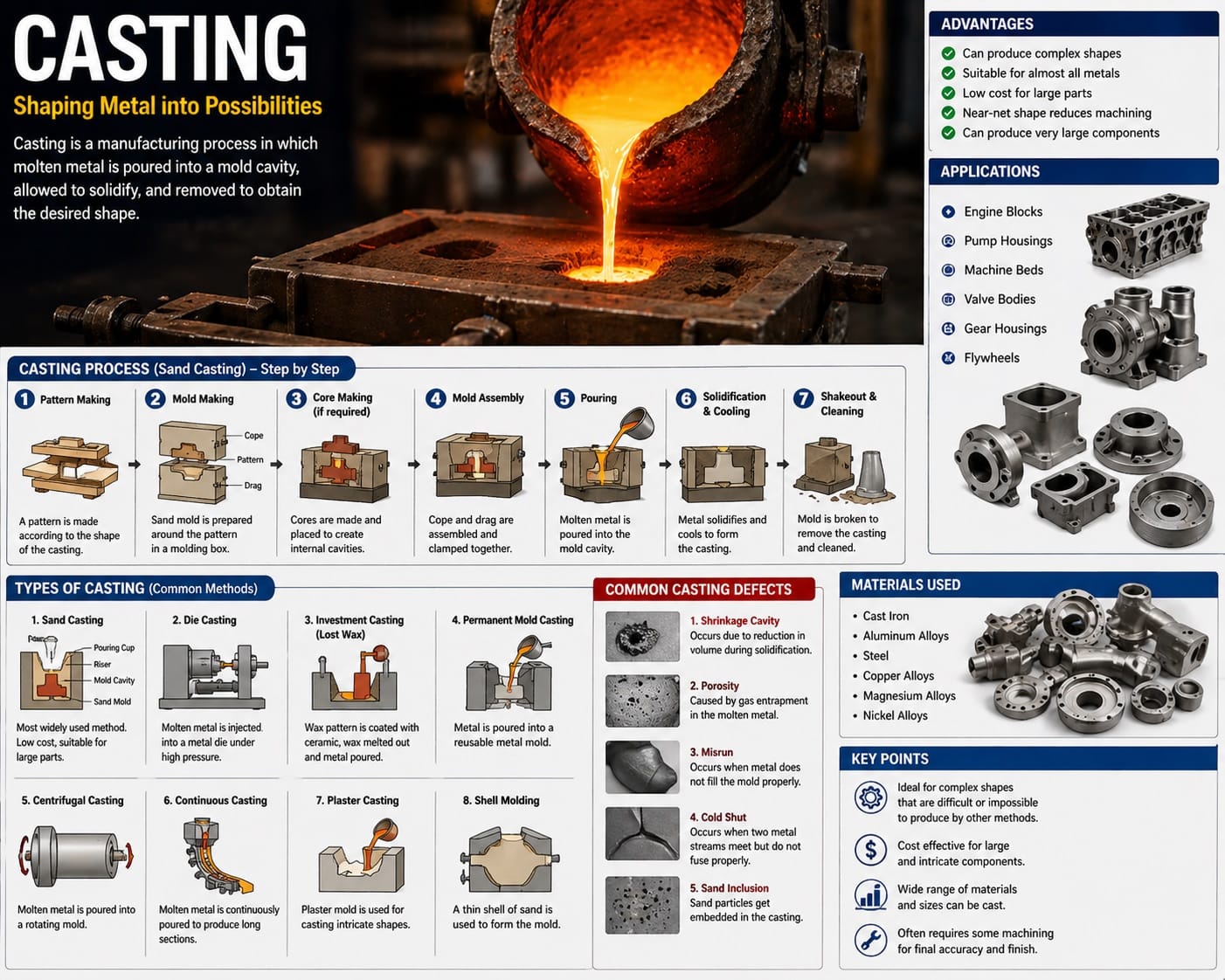
Casting is a manufacturing process where molten metal is poured into a mold cavity. After cooling, the metal solidifies and takes the shape of the mold.
This process is widely used because it allows the creation of complex shapes that are difficult to produce by other methods. For example, engine blocks, pump housings, and machine bases are commonly manufactured using casting.
Types of Casting
- Sand casting
- Die casting
- Investment casting
- Centrifugal casting
Each type has its own advantages depending on accuracy, surface finish, and production volume.
Advantages of Casting
- Suitable for complex geometries
- Cost-effective for mass production
- Can produce large components
- Works with a wide range of metals
Disadvantages of Casting
- Lower strength compared to forging
- Possibility of defects such as porosity
- Requires machining for finishing
- Surface finish may not be smooth
What is Forging?
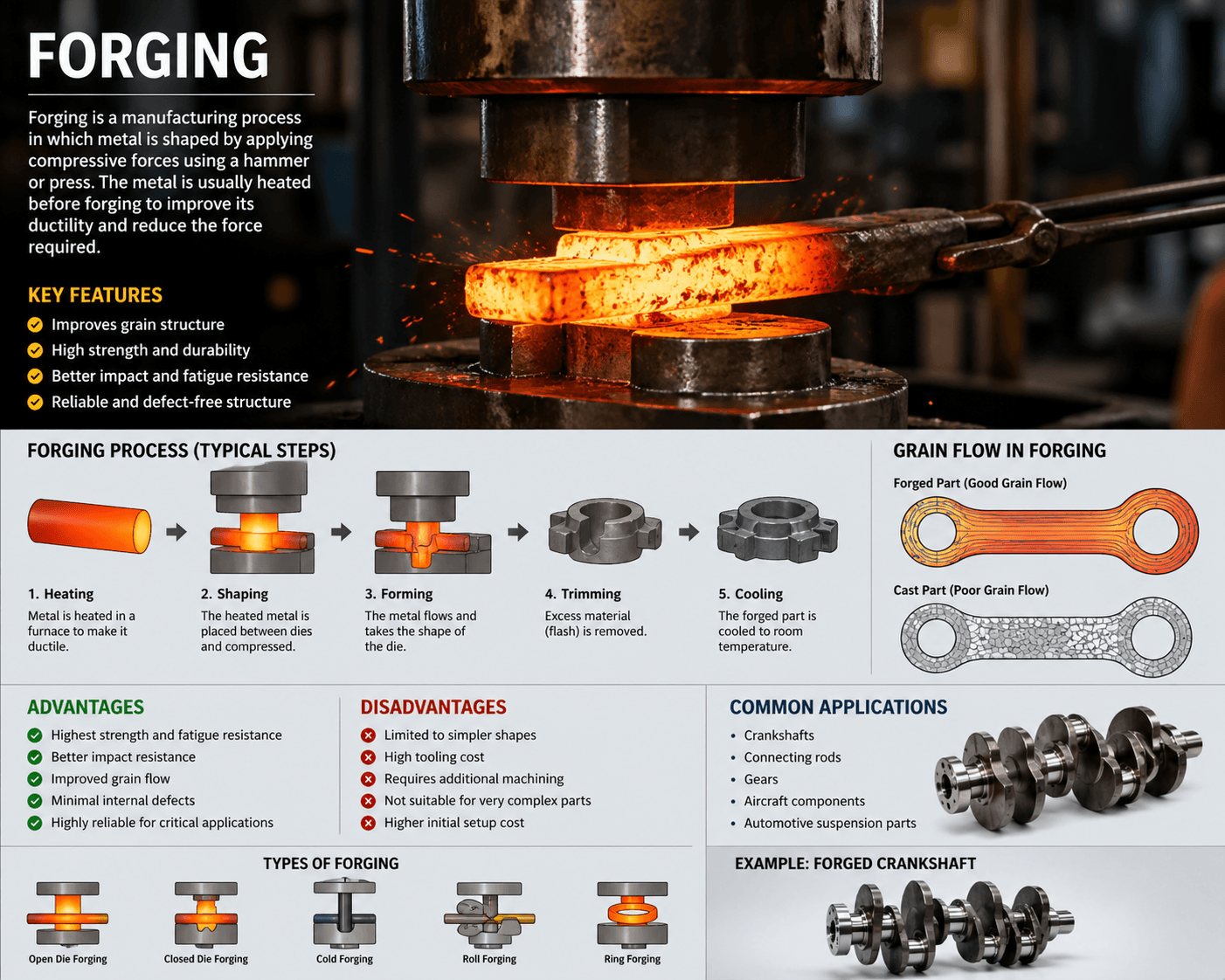
Forging is a manufacturing process where metal is shaped using compressive forces such as hammering or pressing. Usually, the metal is heated before shaping to make it more workable.
Forging improves the internal grain structure of the material. As a result, forged components are stronger and more reliable than cast components.
Types of Forging
- Open die forging
- Closed die forging
- Drop forging
- Cold forging
Advantages of Forging
- High strength and toughness
- Improved grain flow
- Better fatigue resistance
- Reliable for heavy-duty applications
Disadvantages of Forging
- Limited shape complexity
- Higher tooling cost
- Requires powerful machinery
- Not suitable for very large or complex shapes
What is Machining?
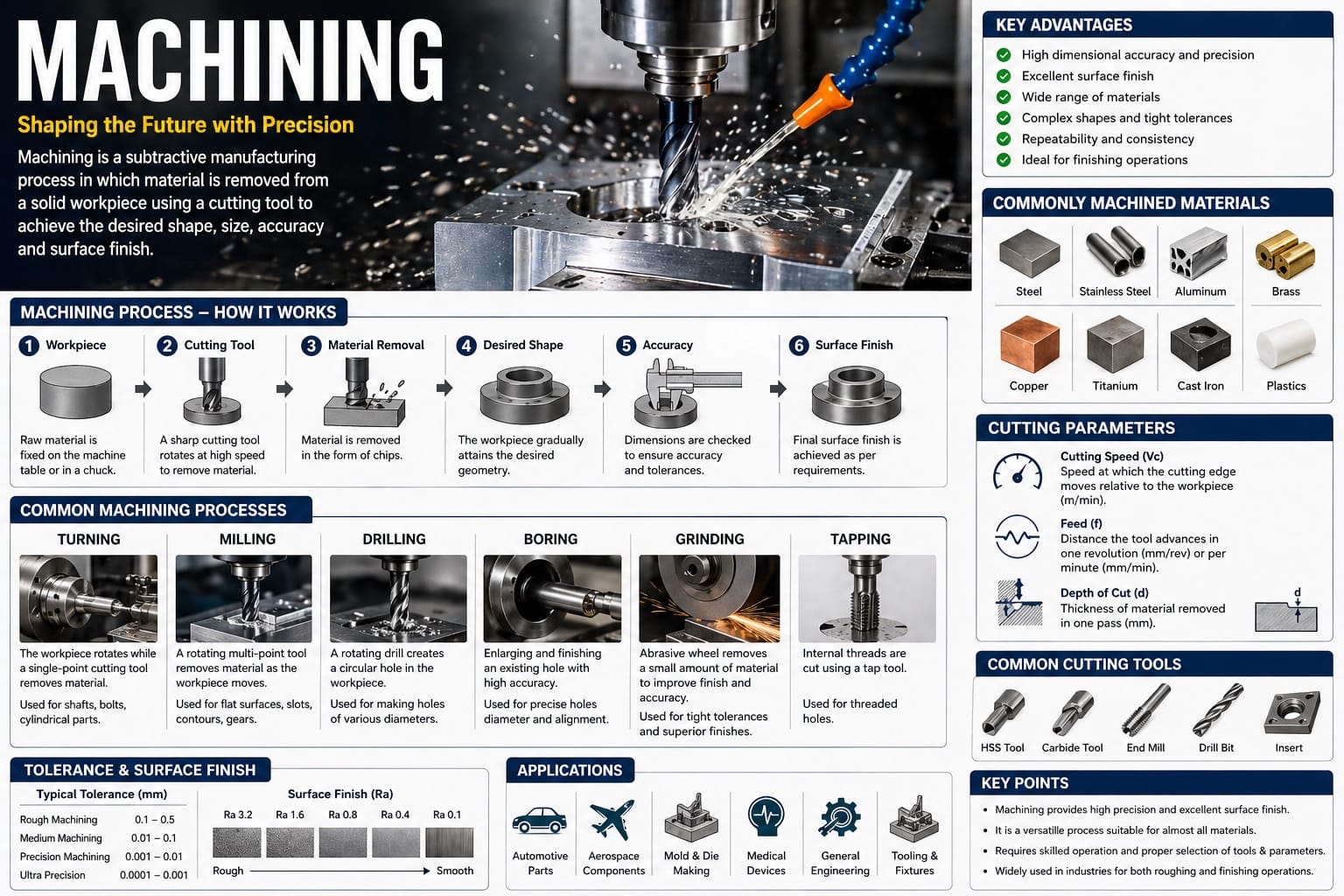
Machining is a subtractive manufacturing process where material is removed from a workpiece using cutting tools to achieve the desired shape and dimensions.
Modern machining uses CNC (Computer Numerical Control) machines, which provide high precision and repeatability. Therefore, machining is essential for producing accurate components.
Common Machining Operations
- Turning
- Milling
- Drilling
- Grinding
- Boring
Advantages of Machining
- High precision and accuracy
- Excellent surface finish
- Suitable for complex dimensions
- Flexible for different designs
Disadvantages of Machining
- Material waste
- Higher production cost
- Slower for mass production
- Requires skilled operators
Key Differences: Casting vs Forging vs Machining
| Feature | Casting | Forging | Machining |
|---|---|---|---|
| Strength | Medium | High | Medium |
| Cost | Low | Medium | High |
| Precision | Medium | Medium | High |
| Shape Complexity | High | Low | High |
| Material Waste | Low | Low | High |
Therefore, each process serves a different purpose depending on application requirements.
Detailed Comparison of Casting vs Forging vs Machining
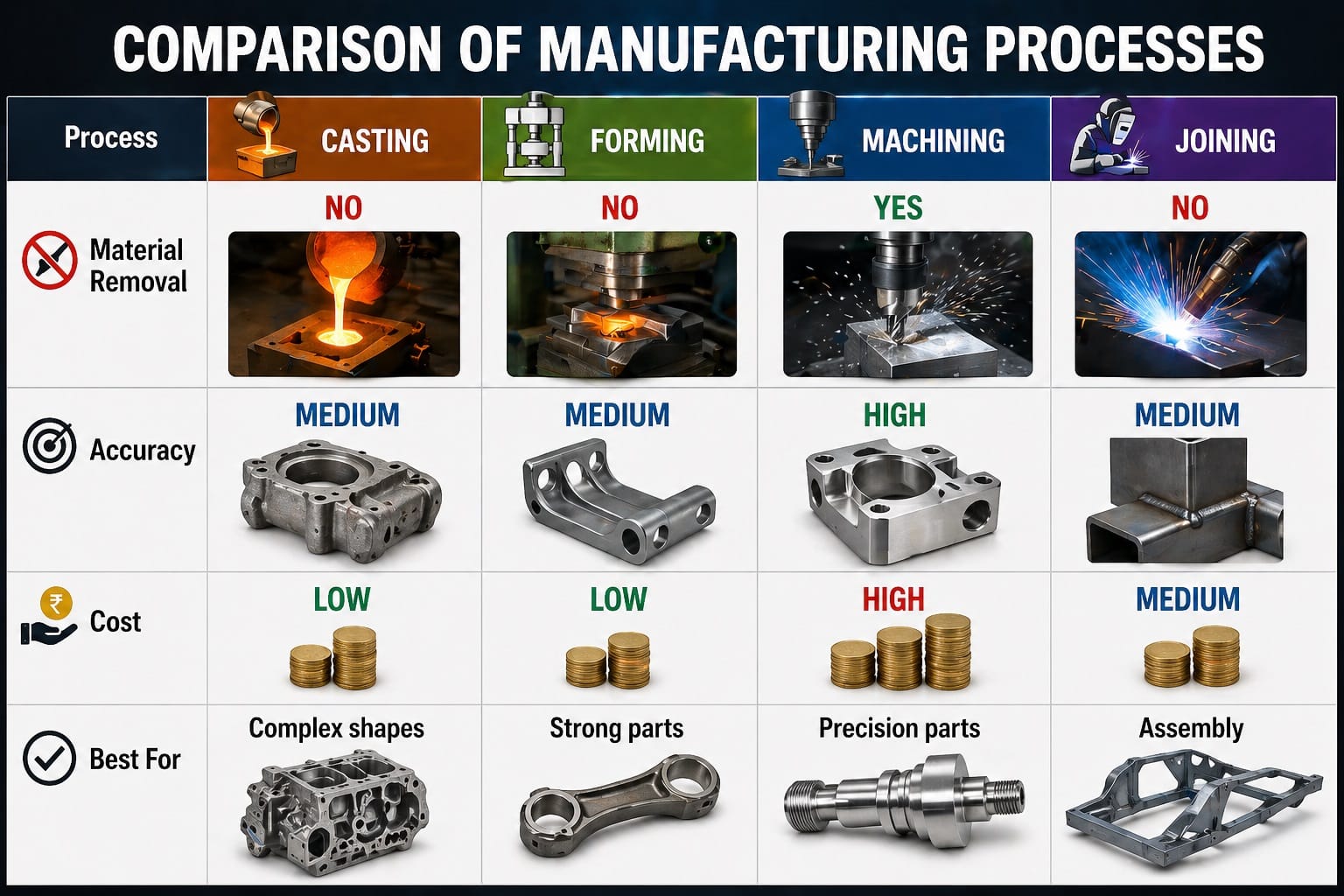
Strength Comparison
Forging provides the highest strength because it improves grain flow. In contrast, casting produces moderate strength due to possible internal defects. Meanwhile, machining depends on the base material.
Cost Comparison
Casting is generally the most economical for large production runs. Forging costs more due to tooling and energy requirements. However, machining is usually the most expensive because of material removal and time.
Precision Comparison
Machining offers the highest precision and best surface finish. Casting provides moderate accuracy, while forging often requires additional machining for finishing.
Production Volume
Casting and forging are suitable for high-volume production. On the other hand, machining is better for low-volume or customized parts.
When to Use Casting, Forging, or Machining?
Choosing the right process depends on multiple factors.
- Use casting when you need complex shapes and large parts
- Use forging when strength and durability are critical
- Use machining when precision and finish are important
In many cases, manufacturers combine these processes to achieve the best results. Furthermore, combining these processes often produces better results. For example, manufacturers may use casting first and machining later.
Real-World Example
Automobile manufacturing uses all three processes.
Engine blocks are produced using casting because of their complex shape. Crankshafts are forged to provide high strength. Gears and shafts are machined for precision. Finally, these parts are assembled into a complete system.
As a result, combining casting, forging, and machining improves performance and reliability.
Cost and Efficiency Considerations
Manufacturers must balance cost and efficiency when selecting a process. Casting reduces cost for large volumes. Forging increases durability but adds cost. Machining ensures accuracy but requires more time and resources.
Therefore, the choice depends on production scale, design complexity, and required performance.
Future Trends in Manufacturing
Modern manufacturing is evolving rapidly. Automation and robotics are improving productivity. In addition, artificial intelligence helps optimize manufacturing processes.
Moreover, hybrid manufacturing is becoming popular. This approach combines additive manufacturing with machining and forging to create advanced components. Modern manufacturing continues to evolve. For example, automation improves production speed. In addition, artificial intelligence enhances quality control. Moreover, Industry 4.0 transforms traditional systems. As a result, industries become more efficient and flexible. Therefore, engineers must stay updated with these trends.
As a result, industries are becoming more efficient and flexible.
Frequently Asked Questions
Which process is strongest?
Forging produces the strongest components due to improved grain structure.
Which process is most accurate?
Machining provides the highest accuracy and surface finish.
Which process is cheapest?
Casting is usually the most cost-effective for large production.
Can these processes be combined?
Yes, many industries combine casting, forging, and machining for better results.
Useful Resources
For global engineering standards and best practices, refer to the ISO (International Organization for Standardization) and the ASME (American Society of Mechanical Engineers)..
You can also use our engineering fabrication calculators for material weight and fabrication estimation.
Conclusion
Casting vs forging vs machining is a key decision in manufacturing. Each process has its own advantages and limitations.
Casting is best for complex shapes, forging provides strength, and machining delivers precision. Therefore, selecting the right process improves efficiency, reduces cost, and enhances product quality.
In the long run, understanding casting vs forging vs machining helps engineers and manufacturers make better decisions and achieve optimal performance. Therefore, selecting the right process improves efficiency and reduces cost. In the long run, this leads to better performance. Finally, understanding these processes helps engineers make informed decisions.
Excellent content—well structured and very helpful for understanding when to use casting, forging, or machining.
Excellent blog, I personally like the image .
[…] Casting vs Forging vs Machining: Complete Comparison Guide (2026) […]