

Types of manufacturing processes with examples are essential in modern engineering and industrial production. Every product around us, such as machines, vehicles, tools, furniture, pipes, gears, and household items, comes from one or more manufacturing methods.
However, choosing the wrong process can increase production cost, reduce product quality, and waste material. For this reason, engineers, students, manufacturers, and workshop owners must understand how different manufacturing processes work. In addition, selecting the correct method helps improve strength, accuracy, speed, and overall production efficiency.
In this guide, you will learn the main types of manufacturing processes with examples, advantages, disadvantages, applications, and selection tips.
What is a Manufacturing Process?
A manufacturing process is a method used to convert raw materials into finished or semi-finished products. Manufacturers use machines, tools, heat, pressure, cutting tools, molds, dies, and skilled labor to create useful products.
For example, a steel component may start as raw material. First, workers may cast it into a rough shape. After that, they may machine it to achieve accurate dimensions. Finally, they may weld it with other parts to complete the product.
Similarly, industries may mold plastic into bottles, form sheet metal into car panels, or machine metal bars into shafts. As a result, manufacturing processes help industries create products at different levels of strength, accuracy, and cost.
Classification of Manufacturing Processes with Examples
Manufacturing processes are usually divided into several major categories. Therefore, this classification helps engineers choose the right method for each application.
Primary Manufacturing Processes
Primary processes convert raw material into a basic shape. These processes usually create the first form of the product.
Examples include casting, forging, rolling, extrusion, and forming.
Secondary Manufacturing Processes
Secondary processes improve shape, accuracy, dimension, and surface finish. In addition, they help achieve tighter tolerances.
Examples include machining, grinding, drilling, milling, and finishing.
Joining Manufacturing Processes
Joining processes connect two or more components. For instance, welding, brazing, soldering, riveting, and bolting are common joining methods.
Additive Manufacturing Processes
Additive processes build parts layer by layer. As a result, they allow complex designs and rapid prototyping.
Examples include 3D printing and selective laser sintering.
Types of Manufacturing Processes with Examples Explained
1. Casting Process Example in Manufacturing
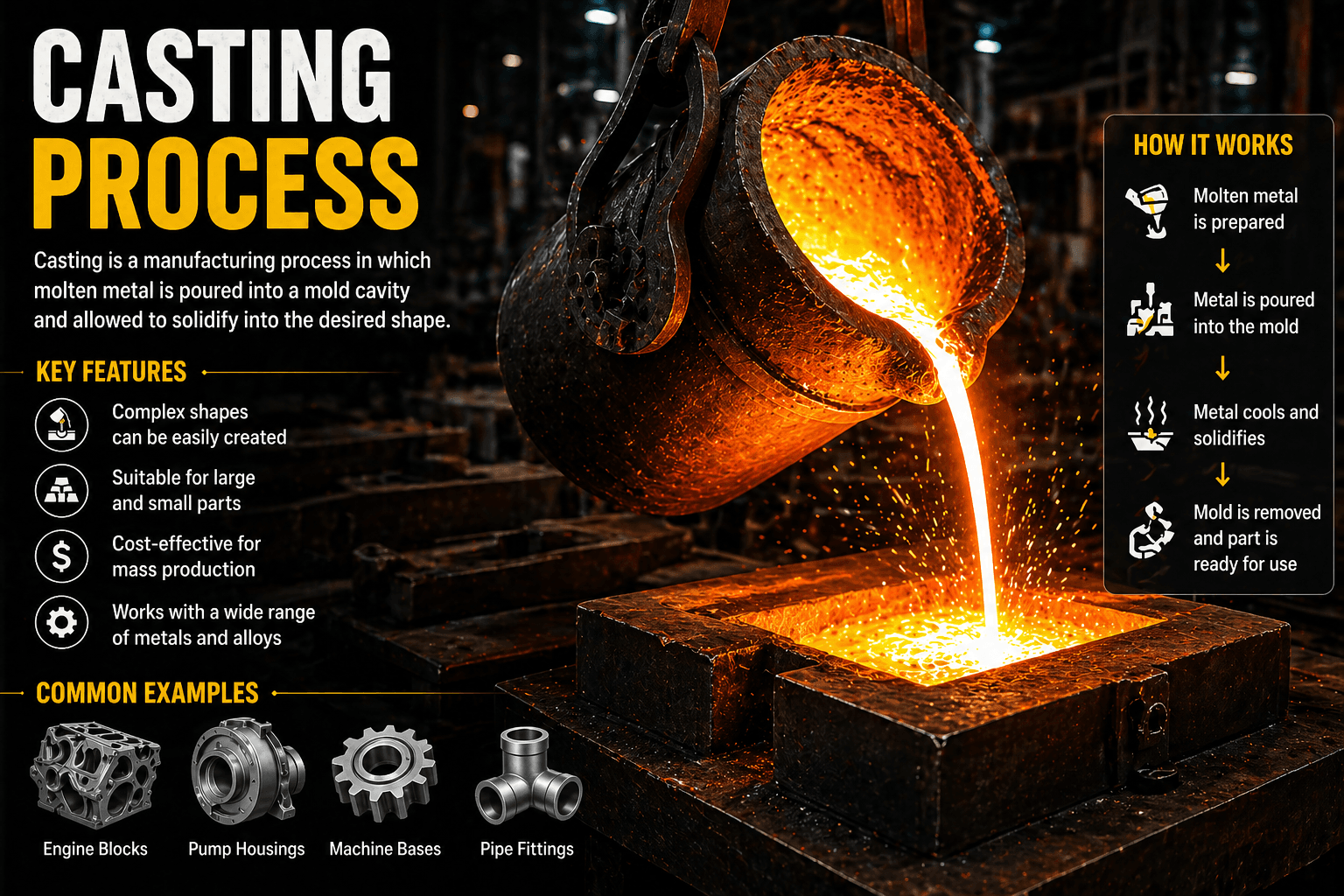
Casting is one of the oldest and most widely used manufacturing processes. In this process, manufacturers pour molten metal into a mold. After cooling, the metal solidifies and takes the shape of the mold.
Casting works well for complex shapes that are difficult to produce by machining or forging. Therefore, industries often use casting for large and complicated components.
Examples of casting products:
- Engine blocks
- Pump housings
- Machine bases
- Valve bodies
- Gearbox casings
Advantages of casting:
- Suitable for complex shapes
- Good for large components
- Cost-effective for mass production
- Works with many metals
Disadvantages of casting:
- May create defects like porosity
- Lower strength than forging
- Surface finish may need improvement
- Dimensional accuracy may vary
Casting is useful when shape complexity matters more than maximum strength.
2. Forging Process Example in Manufacturing
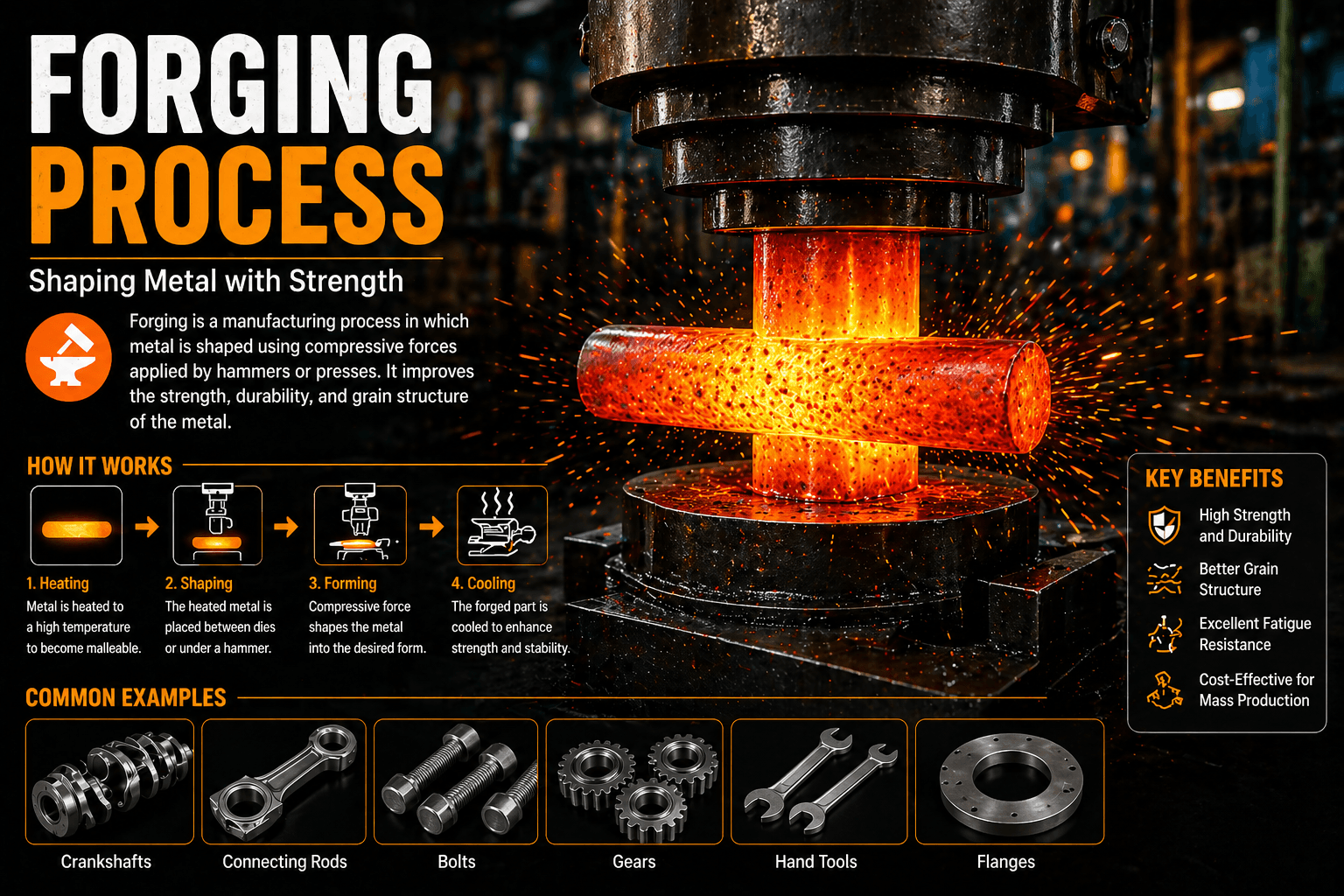
Forging is a manufacturing process where metal is shaped using compressive force. Workers or machines press, hammer, or squeeze the material into the required shape.
Forging improves the grain structure of metal. As a result, forged parts usually have higher strength and durability than cast parts.
Examples of forging products:
- Crankshafts
- Connecting rods
- Fasteners
- Hand tools
- Gear blanks
Advantages of forging:
- Produces strong parts
- Improves grain flow
- Offers high fatigue resistance
- Suitable for load-bearing components
Disadvantages of forging:
- Limited shape complexity
- High tooling cost
- Requires powerful machines
- Not ideal for very complex designs
Forging is best for parts that need strength, toughness, and reliability.
3. Machining Process in Manufacturing
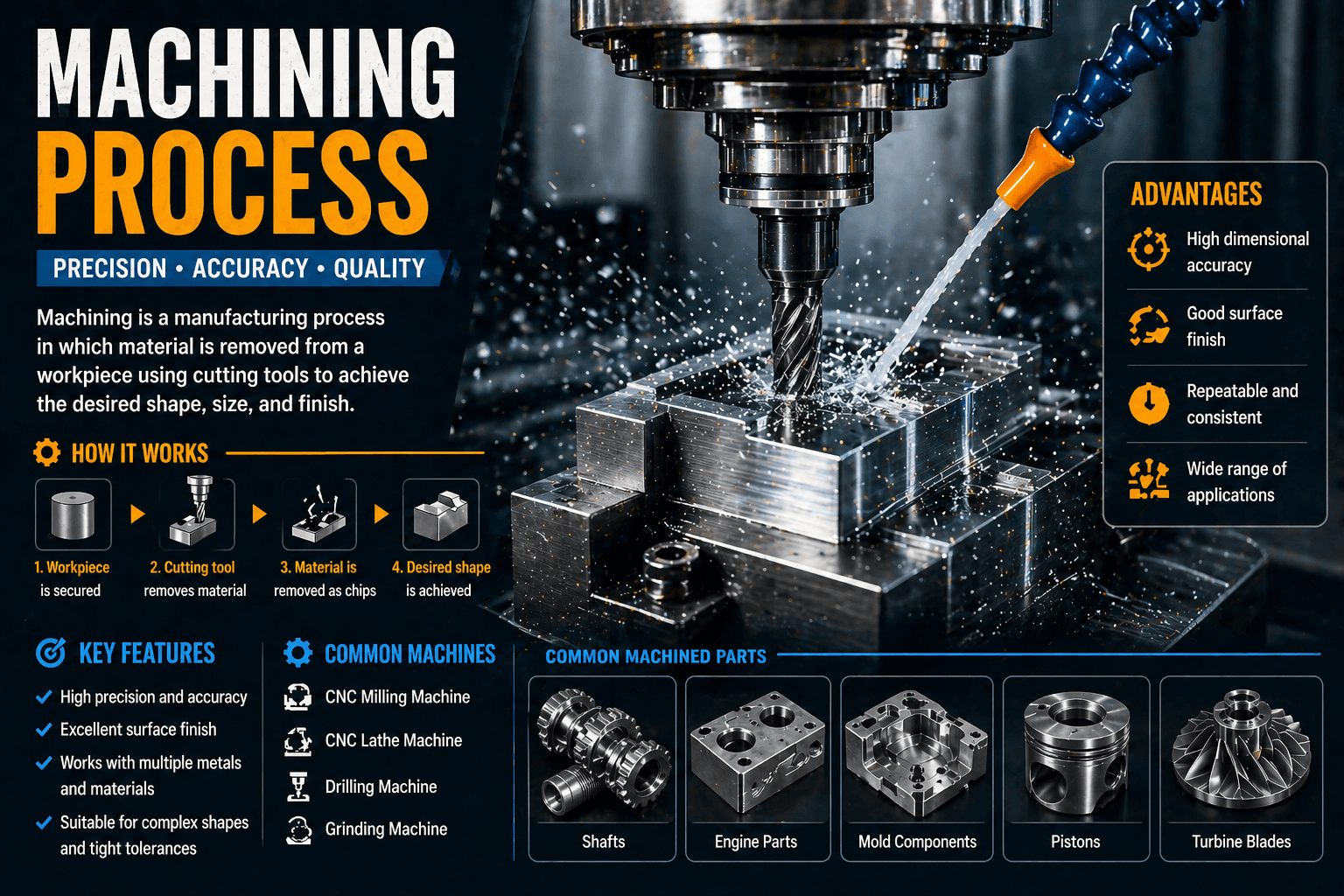
Machining is a subtractive manufacturing process. In this method, cutting tools remove material from a workpiece to create the required shape and size.
Common machining operations include turning, milling, drilling, boring, shaping, and grinding. Moreover, CNC machines now make machining faster and more accurate.
Examples of machining products:
- Shafts
- Gears
- Bushes
- Precision plates
- Machine components
Advantages of machining:
- High precision
- Good surface finish
- Suitable for complex dimensions
- Works well for finishing operations
Disadvantages of machining:
- Creates material waste
- Can be costly for mass production
- Requires skilled operators
- Slower than some forming methods
Machining is useful when accuracy, tolerance, and surface finish are very important.
4. Welding Process in Manufacturing
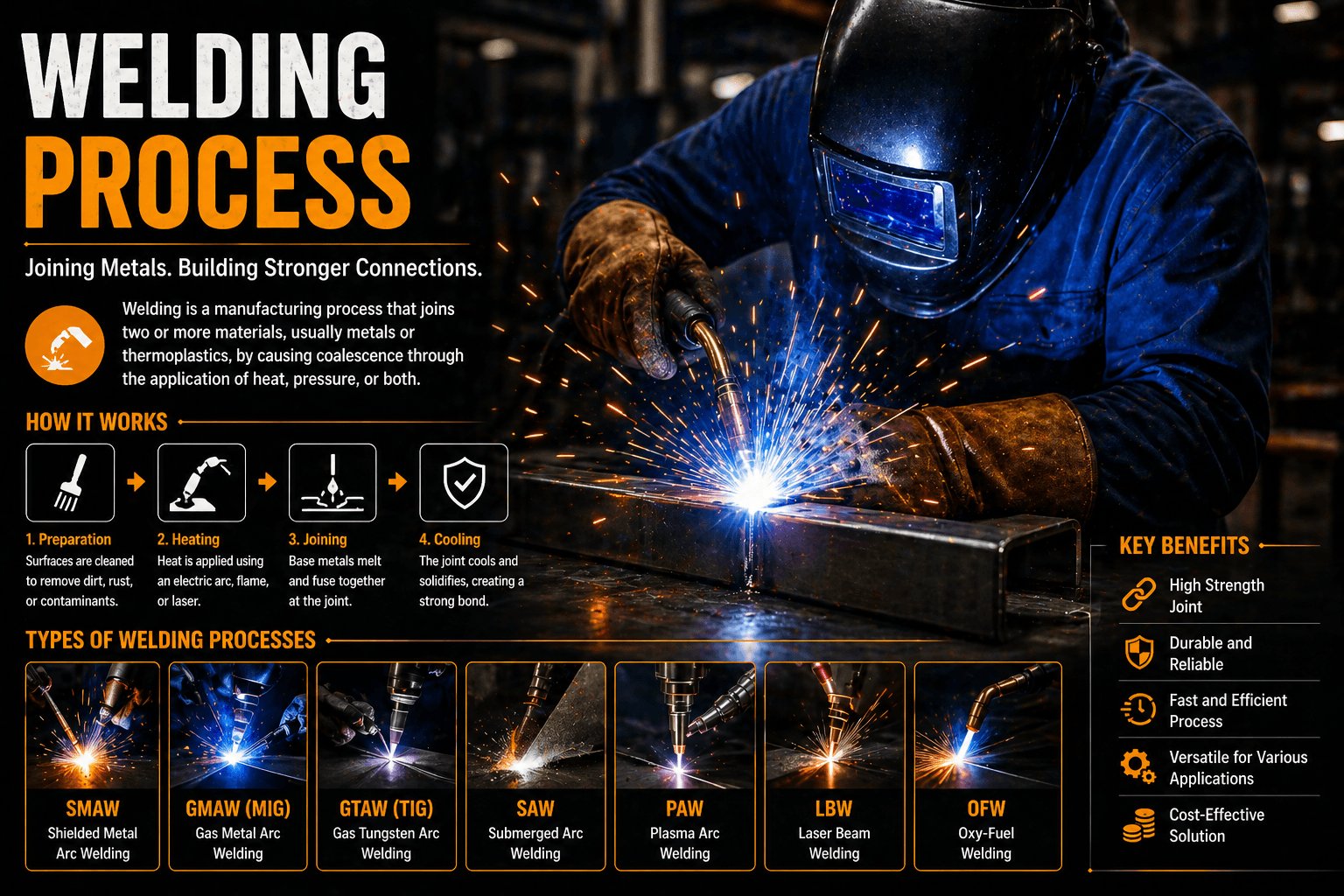
Welding is a joining process used to connect two or more metal parts. It uses heat, pressure, or both to create a strong permanent joint.
Industries use welding in fabrication, construction, shipbuilding, pipelines, pressure vessels, and structural work. In addition, welding helps create large assemblies from smaller parts.
Examples of welding applications:
- Bridges
- Pipelines
- Tanks
- Structural frames
- Fabricated machine parts
Advantages of welding:
- Creates strong joints
- Suitable for large structures
- Permanent connection
- Flexible and widely used
Disadvantages of welding:
- Requires skilled labor
- Heat can affect material properties
- May create distortion
- Inspection may be required
Welding is best when components must be joined strongly and permanently.
5. Forming Process in Manufacturing
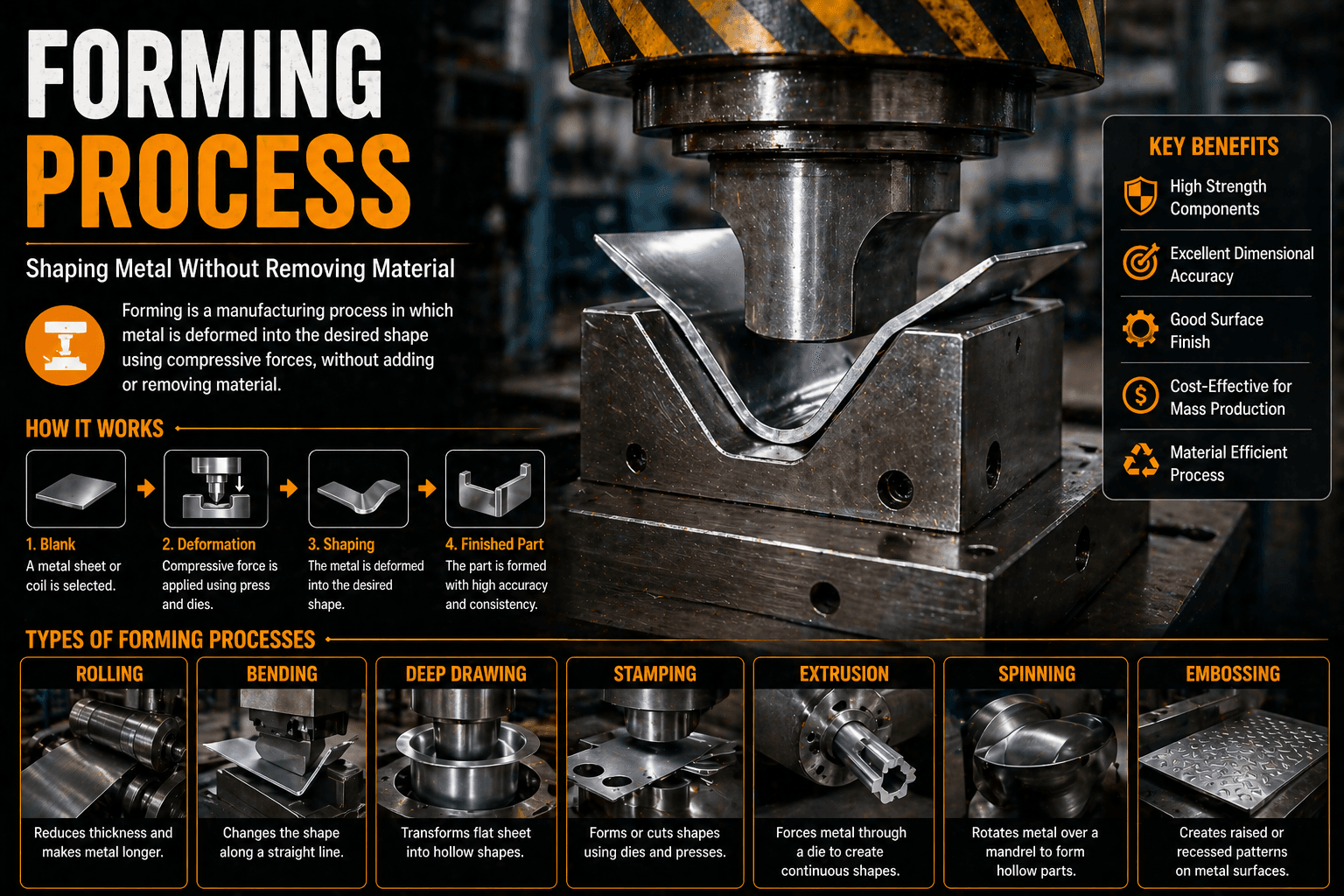
Forming changes the shape of material without removing it. Instead of cutting material away, forming uses force to bend, stretch, roll, or press the material.
This process is common in sheet metal industries. Therefore, manufacturers use forming for automotive panels, brackets, covers, and enclosures.
Examples of forming products:
- Car body panels
- Sheet metal boxes
- Brackets
- Pipes
- Metal covers
Advantages of forming:
- Low material waste
- High production speed
- Good mechanical properties
- Suitable for mass production
Disadvantages of forming:
- Needs dies and tools
- Limited to certain shapes
- Material may crack if not controlled
- Setup cost can be high
Forming is suitable for sheet metal parts and high-volume production.
6. Additive Manufacturing Process 3D Printing
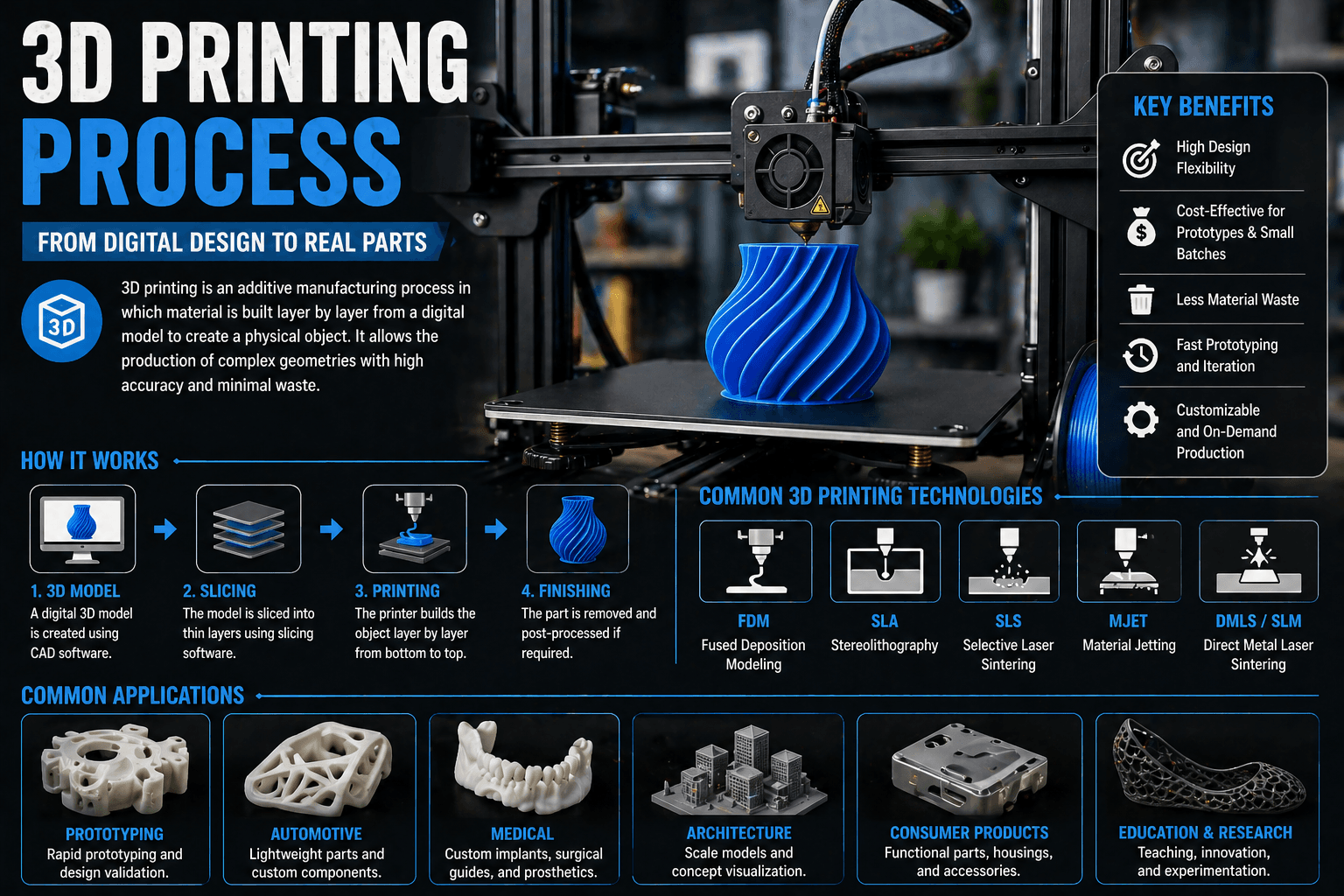
Additive manufacturing, also known as 3D printing, builds parts layer by layer using digital models. Unlike machining, it adds material instead of removing it.
This method helps designers create complex shapes that traditional methods cannot produce easily. Moreover, it is useful for prototypes, custom parts, and lightweight designs.
Examples of 3D printing products:
- Prototypes
- Medical implants
- Custom brackets
- Design models
- Aerospace parts
Advantages of 3D printing:
- Creates complex designs
- Reduces material waste
- Good for prototypes
- Useful for customization
Disadvantages of 3D printing:
- Slower for mass production
- Material strength may vary
- Cost can be high for large parts
- Limited material options in some cases
3D printing is best for prototyping, custom parts, and design testing.
7. Powder Metallurgy Process
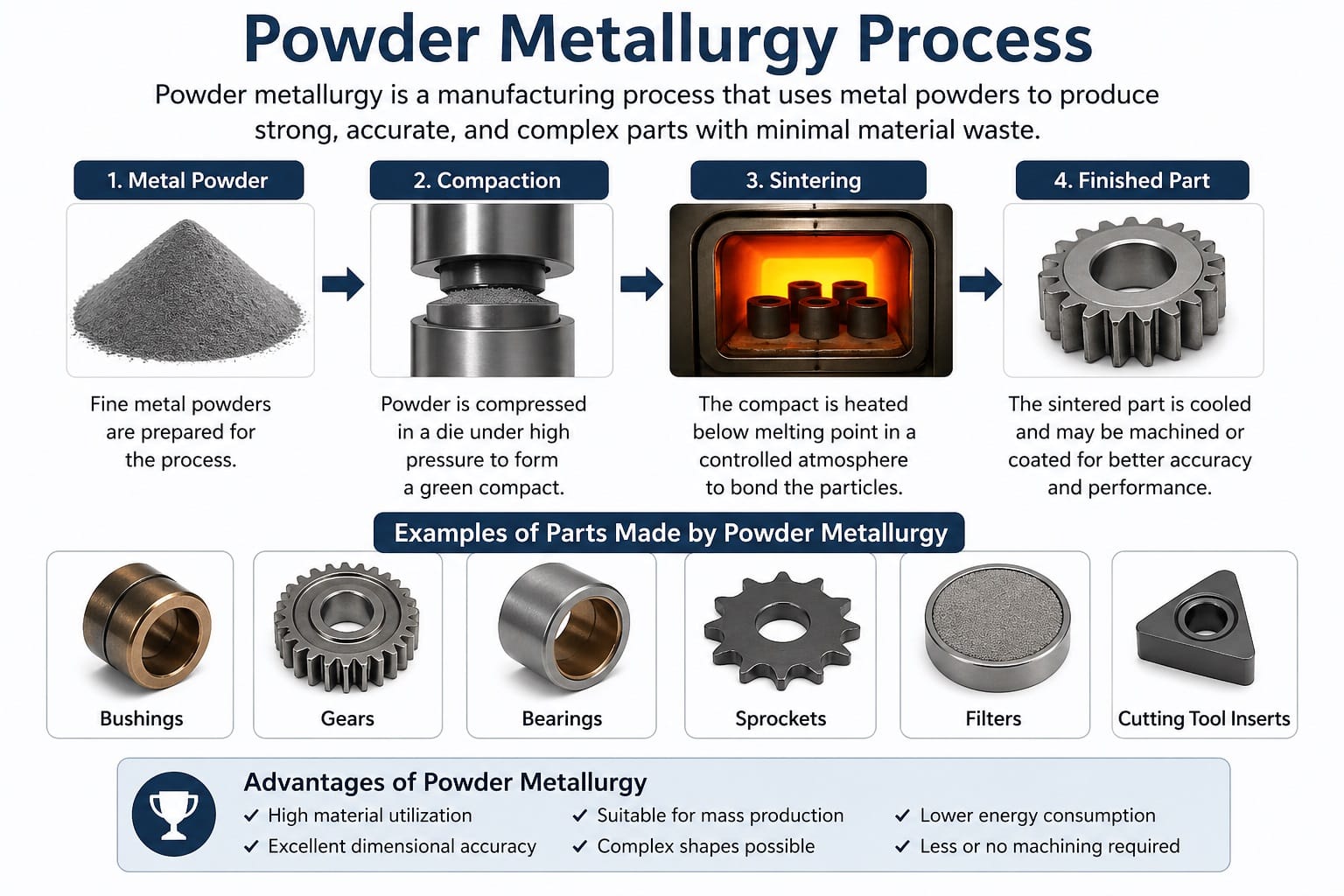
Powder metallurgy uses metal powders to create solid parts. First, manufacturers compact metal powder into a die. Then, they heat it below melting point to bond particles together.
This process is useful for small, accurate, and high-volume parts. As a result, many automotive and mechanical components use powder metallurgy.
Examples of powder metallurgy products:
- Bearings
- Small gears
- Bushes
- Filters
- Cutting tool inserts
Advantages of powder metallurgy:
- High material utilization
- Good dimensional accuracy
- Suitable for mass production
- Less machining required
Disadvantages of powder metallurgy:
- Limited part size
- High initial tooling cost
- Not ideal for all materials
- Strength may be lower than forged parts
Powder metallurgy works well when accuracy and material saving are important.
Comparison of Manufacturing Processes
| Process | Strength | Cost | Precision | Best Use |
|---|---|---|---|---|
| Casting | Medium | Low | Medium | Complex shapes |
| Forging | High | Medium | Medium | Strong parts |
| Machining | Medium | High | High | Precision components |
| Welding | High | Low | Medium | Joining parts |
| Forming | Medium | Low | Medium | Sheet metal products |
| 3D Printing | Low to Medium | Medium | High | Prototypes |
| Powder Metallurgy | Medium | Medium | High | Small mass-produced parts |
This comparison shows that no single process is best for every product. Therefore, engineers must select the method based on cost, strength, accuracy, material, and production volume.
How to Choose the Right Manufacturing Process?
Choosing the right manufacturing process depends on several practical factors. First, check the shape of the part. If the part has a complex shape, casting may be suitable. However, if the part requires high strength, forging may be better.
Next, consider accuracy. If the product needs tight tolerance, machining is usually the best choice. In addition, consider production quantity. For mass production, forming, casting, or powder metallurgy may reduce cost.
Use this simple guide:
- Choose casting for complex metal shapes
- Choose forging for high-strength parts
- Choose machining for precision and finishing
- Choose welding for joining components
- Choose forming for sheet metal work
- Choose 3D printing for prototypes and custom parts
- Choose powder metallurgy for small accurate components
As a result, the right selection improves performance, reduces waste, and controls production cost.
Real-World Example of Manufacturing Processes
Automobile manufacturing uses many manufacturing processes together. For example, manufacturers cast engine blocks because they have complex internal shapes. Then, they forge crankshafts because these parts need high strength.
After that, they machine gears, shafts, and engine parts to achieve precise dimensions. Meanwhile, they form sheet metal panels to create the car body. Finally, they weld different body parts and structures together.
This example proves that industries rarely depend on one process only. Instead, they combine several processes to achieve the best result.
Importance of Manufacturing Processes
Understanding manufacturing processes helps engineers and businesses make better decisions. It also helps reduce production cost and improve quality.
For students, this knowledge builds a strong foundation in mechanical and manufacturing engineering. For workshop owners, it improves estimation, planning, and process selection. Moreover, for manufacturers, it supports better design and production strategy.
Key benefits include:
- Better product quality
- Lower production cost
- Reduced material waste
- Improved process planning
- Better material selection
- Higher production efficiency
Therefore, manufacturing process knowledge is useful for both learning and real industrial work.
Future Trends in Manufacturing Processes
Modern manufacturing continues to improve with technology. For example, automation and robotics help industries increase speed and reduce human error. In addition, artificial intelligence supports quality control and process optimization.
Moreover, Industry 4.0 connects machines, sensors, and data systems. As a result, manufacturers can monitor production in real time and improve efficiency.
3D printing is also growing quickly. It helps companies create prototypes faster and reduce development time. In the future, smart factories will use more digital tools, automation, and advanced materials.
Therefore, engineers must stay updated with new manufacturing trends to remain competitive.
Frequently Asked Questions
What are the main types of manufacturing processes?
The main types include casting, forging, machining, welding, forming, additive manufacturing, and powder metallurgy.
Which manufacturing process gives the highest strength?
Forging usually gives the highest strength because it improves metal grain structure and fatigue resistance.
Which manufacturing process gives the best accuracy?
Machining gives the best accuracy because cutting tools can create precise dimensions and smooth surfaces.
Which manufacturing process is best for complex shapes?
Casting is best for complex shapes because molten metal can fill detailed mold cavities.
Which process is best for prototypes?
3D printing is best for prototypes because it creates custom parts quickly from digital designs.
Useful Resources
For global engineering standards and best practices, refer to the ISO (International Organization for Standardization) and the ASME (American Society of Mechanical Engineers)..
You can also use our engineering fabrication calculators for material weight and fabrication estimation.
Understanding types of manufacturing processes with examples helps engineers and manufacturers select the most efficient method for production and improve overall product quality.
Conclusion
Types of manufacturing processes with examples help engineers, students, and manufacturers understand how products are made. Each process has its own advantages, limitations, and applications.
Casting works well for complex shapes, while forging provides strength. Machining gives precision, welding joins parts, and forming supports sheet metal production. In addition, 3D printing helps with prototypes, and powder metallurgy supports small accurate parts. Understanding types of manufacturing processes with examples helps engineers choose the right method for better performance and cost efficiency.
In the long run, selecting the correct manufacturing process improves quality, reduces cost, and increases productivity. Therefore, understanding these methods helps you make better engineering and production decisions.