

Welding Types Explained is an important topic in fabrication and manufacturing industries because different welding processes are used for different materials, thicknesses and industrial applications. This guide explains MIG welding, TIG welding, SMAW, FCAW and other commonly used welding methods. Welding is one of the most important manufacturing and fabrication processes used in industries such as construction, pressure vessel manufacturing, automotive, aerospace, shipbuilding, pipelines, and structural steel fabrication. Different welding methods are used depending on material type, thickness, strength requirements, production speed, and fabrication standards.
In this guide by The Fab Guru, we explain the major welding types, their working principles, applications, advantages, disadvantages, and industrial uses.
What is Welding?
Welding is a fabrication process used to permanently join two or more metal or thermoplastic parts by applying heat, pressure, or both. The welded joint becomes strong and durable after cooling.
Industries use welding for:
- Structural fabrication
- Pressure vessels
- Pipelines
- Automotive manufacturing
- Heavy engineering
- Machinery fabrication
- Shipbuilding
Types of Welding Processes
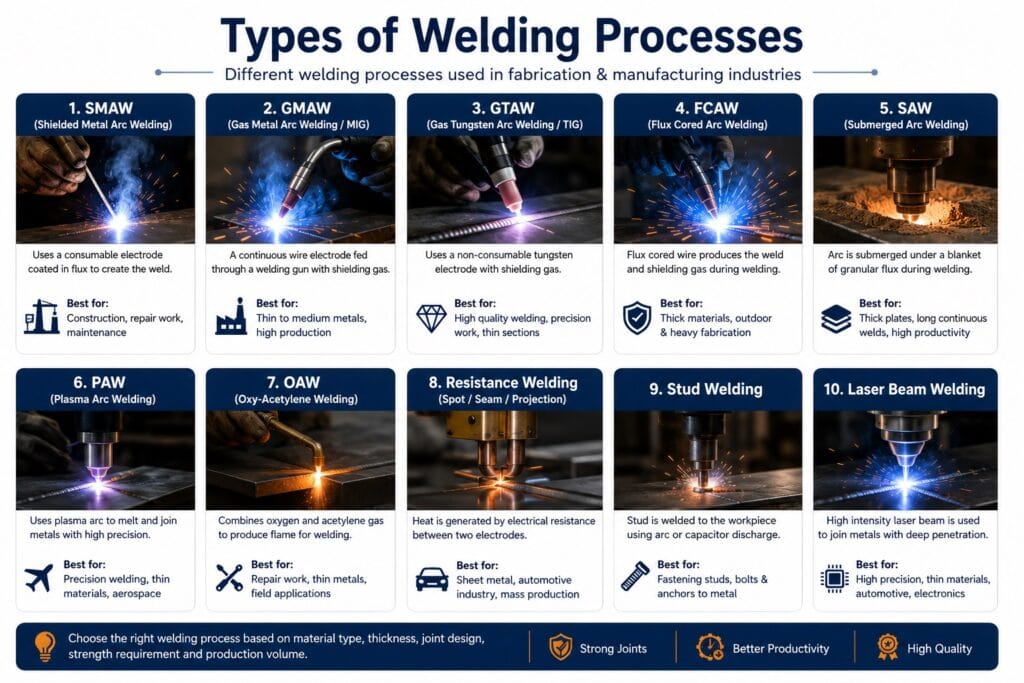
1. SMAW Welding Types Explained
Also known as:
- Stick Welding
- Manual Metal Arc Welding (MMA)
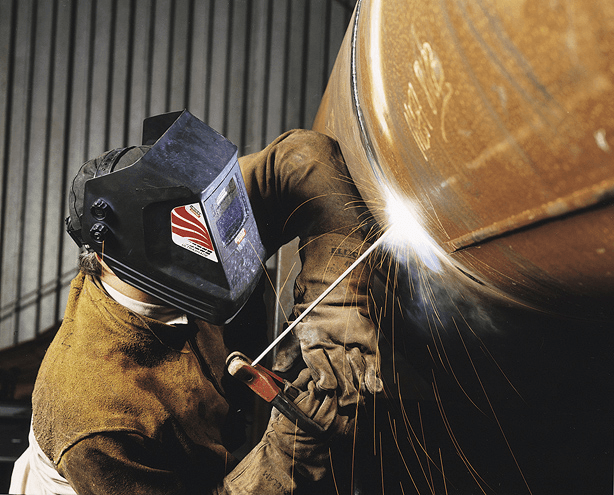
How It Works
An electric arc forms between a coated electrode and the workpiece. The electrode coating produces shielding gas that protects the weld from contamination.
Applications
- Structural steel fabrication
- Construction work
- Repair welding
- Outdoor fabrication
Advantages
- Low equipment cost
- Portable
- Works outdoors
- Suitable for thick materials
Disadvantages
- Slower process
- More slag cleaning
- Requires skilled operator
Common Electrodes
- E6013
- E7018
- E6010
2. Gas Metal Arc Welding (GMAW / MIG Welding)
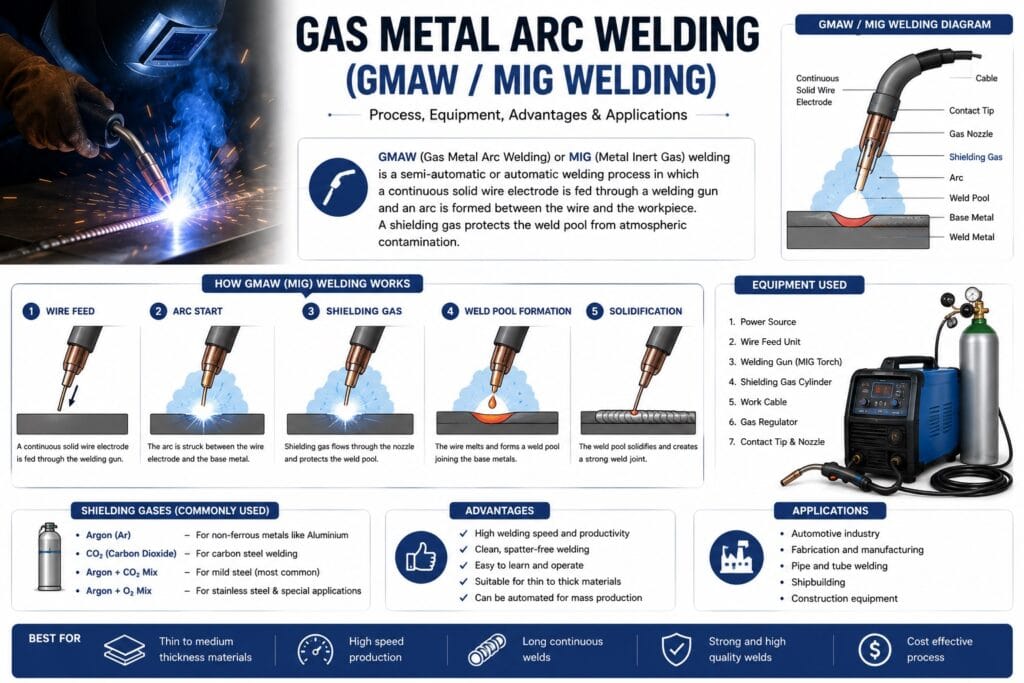
Also called:
- MIG Welding
How It Works
A continuously fed wire electrode melts and joins the metal while shielding gas protects the weld area.
Applications
- Automotive industry
- Sheet metal fabrication
- Stainless steel fabrication
- Production manufacturing
Advantages
- Fast welding speed
- Clean weld appearance
- Less slag
- Easy to automate
Disadvantages
- Sensitive to wind
- Higher equipment cost
- Requires shielding gas
Common Shielding Gases
- Argon
- CO₂
- Argon-CO₂ mixture
3. Gas Tungsten Arc Welding (GTAW / TIG Welding)
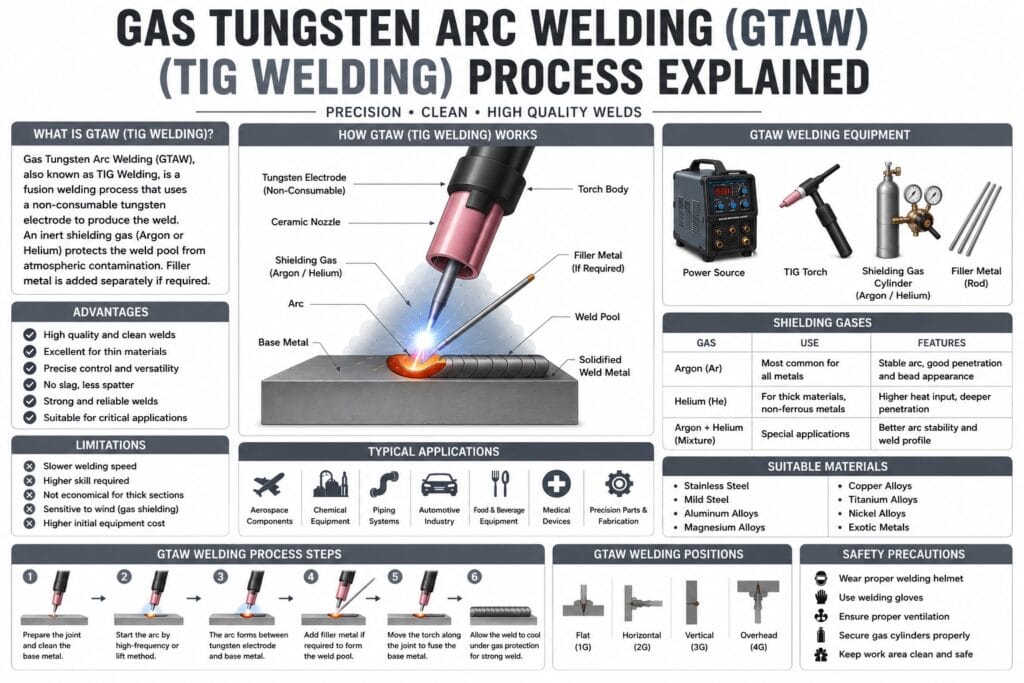
Also called:
- TIG Welding
How It Works
A non-consumable tungsten electrode produces the arc while filler metal may be added separately.
Applications
- Aerospace components
- Stainless steel piping
- Pressure vessels
- Food-grade fabrication
- Thin sheet welding
Advantages
- High-quality weld finish
- Precise control
- Excellent for stainless steel and aluminum
- Minimal spatter
Disadvantages
- Slow process
- Requires high skill
- Expensive equipment
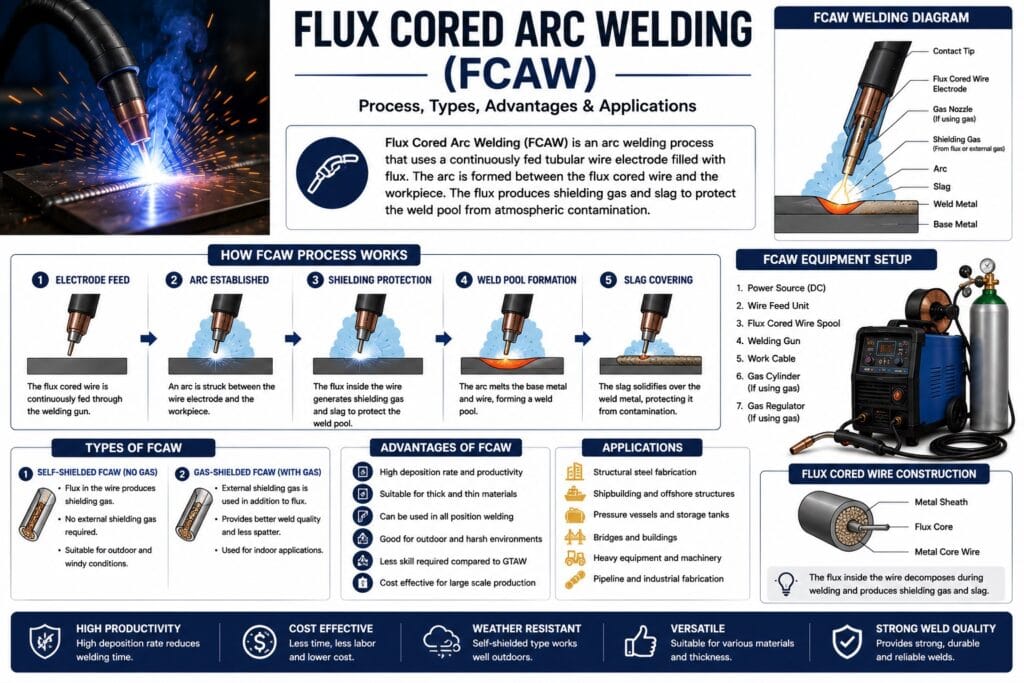
4. Flux Cored Arc Welding (FCAW)
How It Works
Uses a tubular wire filled with flux instead of solid wire.
Applications
- Heavy fabrication
- Structural steel
- Outdoor welding
- Shipbuilding
Advantages
- High deposition rate
- Good for thick sections
- Works in outdoor conditions
Disadvantages
- Generates slag
- More fumes
- Higher consumable cost
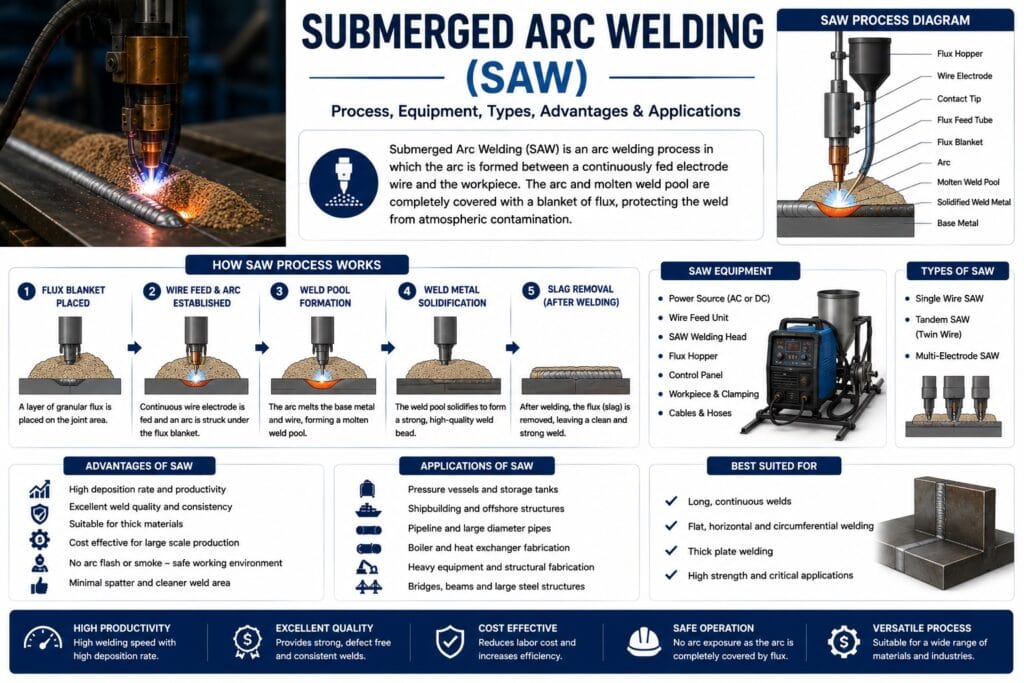
5. Submerged Arc Welding (SAW)
How It Works
The welding arc is submerged under granular flux during welding.
Applications
- Pressure vessel fabrication
- Pipe manufacturing
- Heavy structural fabrication
- Tank manufacturing
Advantages
- Deep penetration
- High productivity
- Excellent weld quality
- Low spatter
Disadvantages
- Limited welding positions
- Mostly used in automated systems
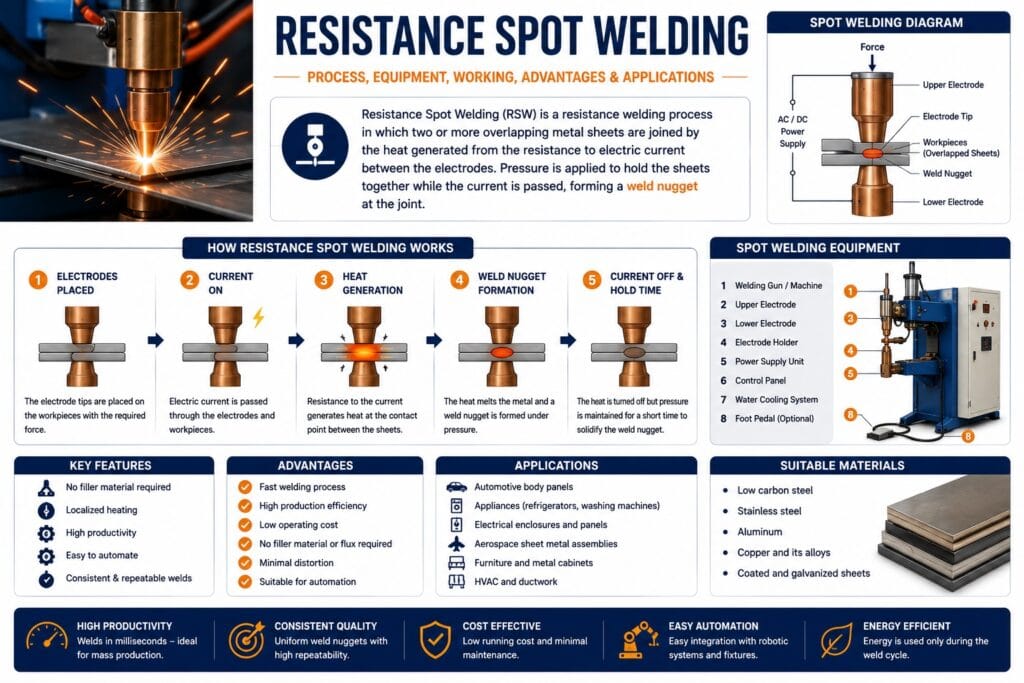
6. Resistance Spot Welding
How It Works
Pressure and electric current generate heat between metal sheets.
Applications
- Automobile body manufacturing
- Sheet metal assembly
Advantages
- Very fast
- No filler metal required
- Easy automation
Disadvantages
- Limited to thin sheets
- High equipment cost
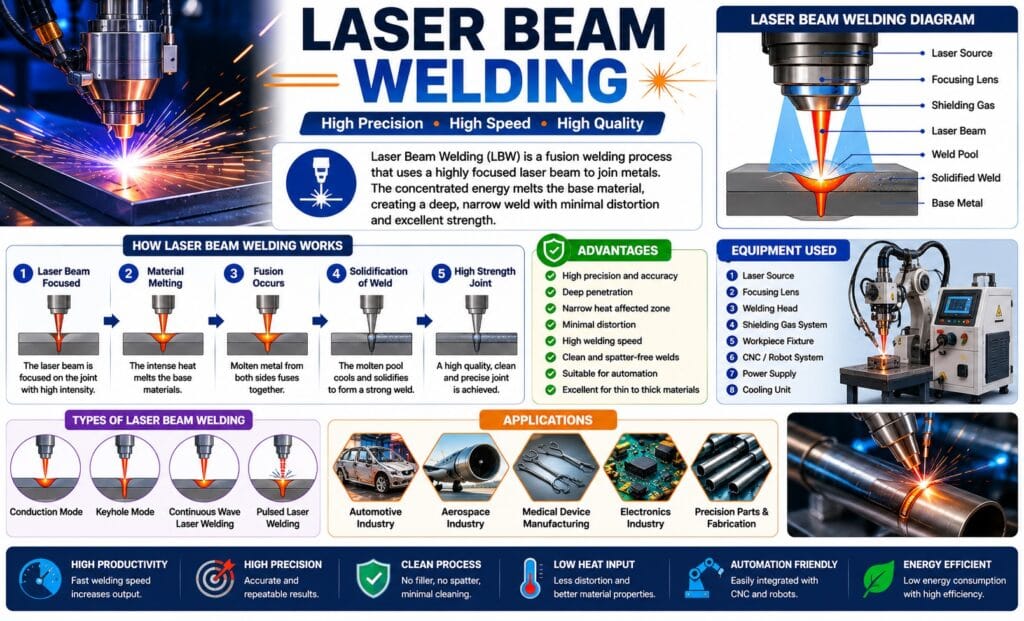
7. Laser Beam Welding
How It Works
A focused laser beam melts the metal and creates the weld.
Applications
- Aerospace
- Automotive
- Precision manufacturing
- Electronics
Advantages
- High precision
- Low distortion
- Very fast
Disadvantages
- Expensive equipment
- Complex maintenance
8. Plasma Arc Welding
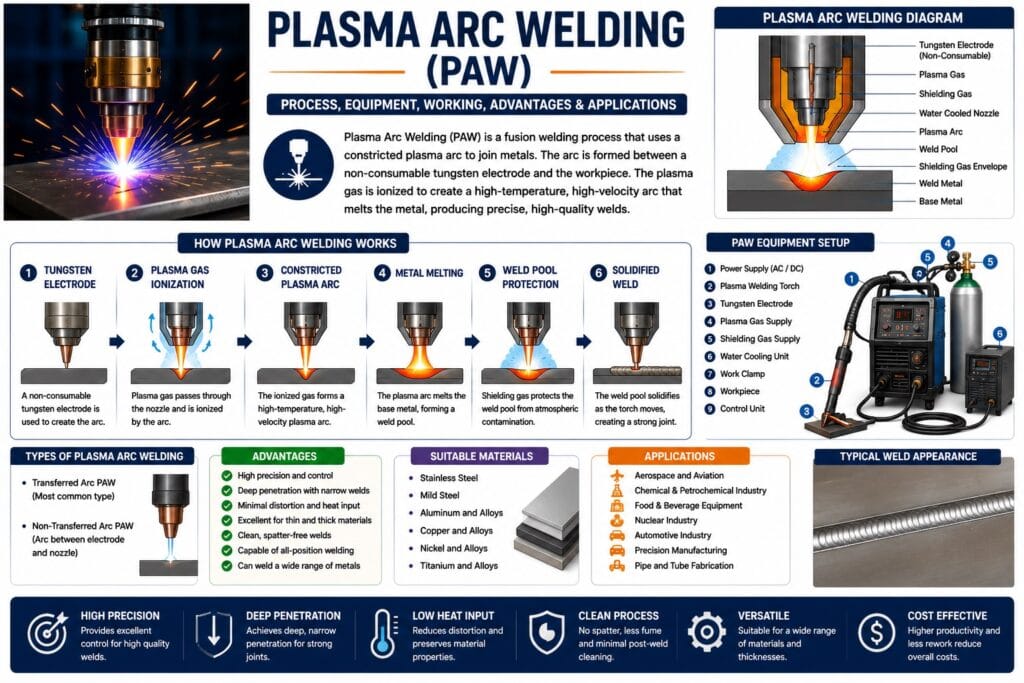
Applications
- Aerospace fabrication
- Precision stainless steel welding
Advantages
- Stable arc
- High-quality welds
- Suitable for thin materials
Disadvantages
- Expensive setup
- Skilled operation required
Welding Position Types
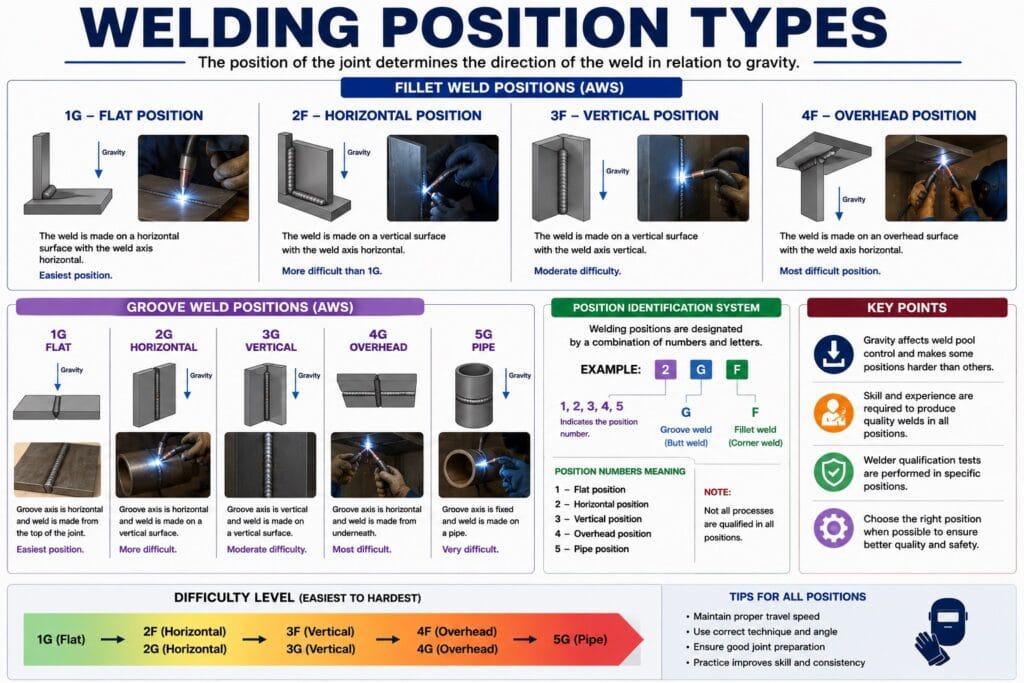
Flat Position (1G / 1F)
Best and easiest welding position.
Horizontal Position (2G / 2F)
Used for structural and pipe welding.
Vertical Position (3G / 3F)
More difficult due to gravity.
Overhead Position (4G / 4F)
Most challenging welding position.
Welding Joint Types
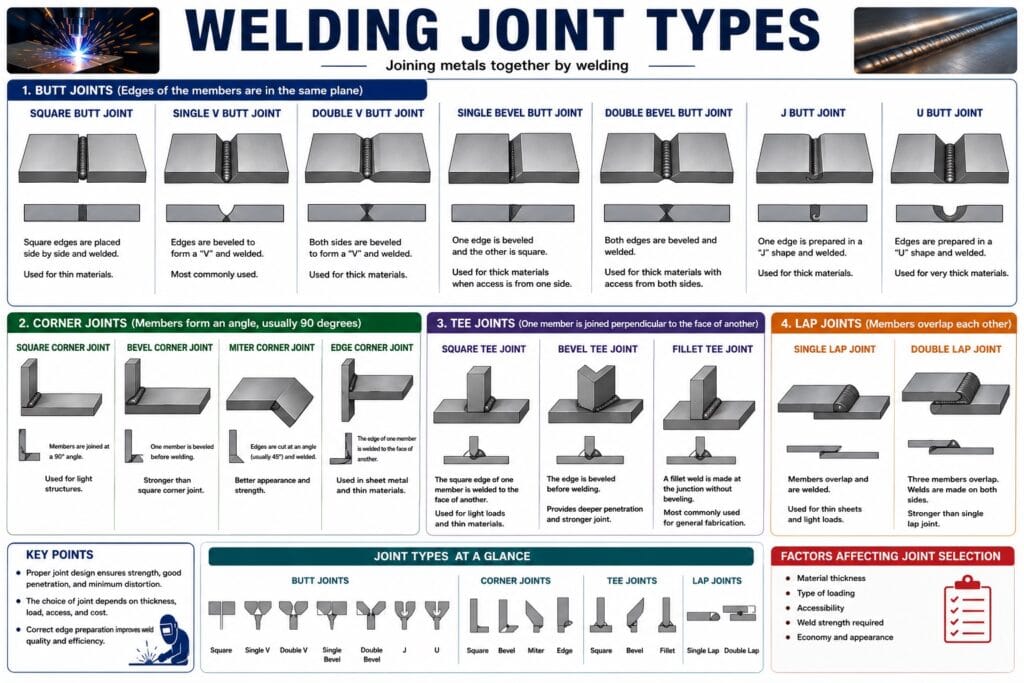
Butt Joint
Common in pipes and plates.
Fillet Joint
Used in structural fabrication.
Lap Joint
Common in sheet metal fabrication.
Corner Joint
Used in box fabrication.
Edge Joint
Used for thin plates.
Comparison of Welding Types
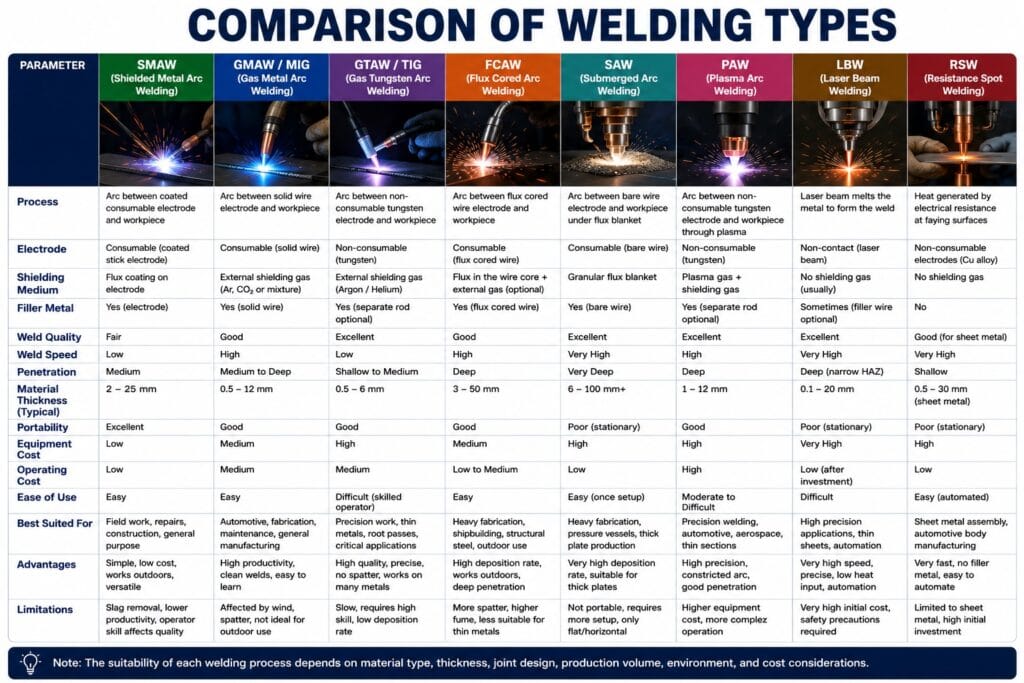
| Welding Type | Speed | Quality | Cost | Best For |
|---|---|---|---|---|
| SMAW | Medium | Good | Low | Construction |
| MIG | High | Very Good | Medium | Production |
| TIG | Low | Excellent | High | Precision Work |
| FCAW | High | Good | Medium | Heavy Fabrication |
| SAW | Very High | Excellent | High | Pressure Vessels |
Welding Safety Precautions
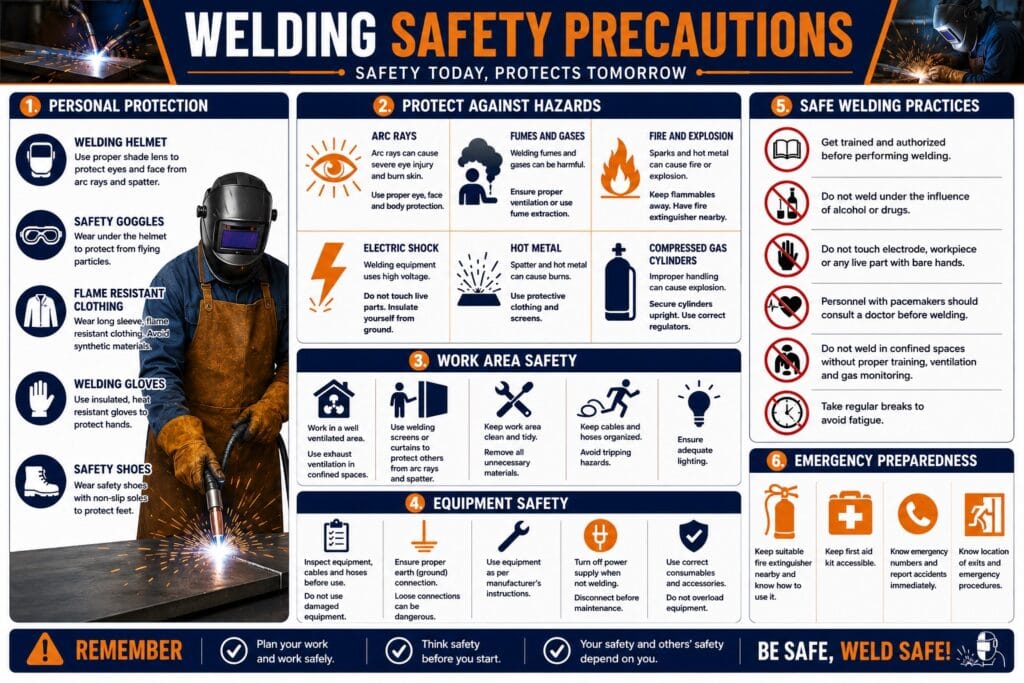
Always follow welding safety practices:
- Wear welding helmet
- Use gloves and PPE
- Ensure ventilation
- Avoid electric shock
- Use fire-resistant clothing
- Follow welding procedure specifications (WPS)
Industrial Standards for Welding
Important welding standards include:
Frequently Asked Questions (FAQ)
Which welding type is strongest?
TIG welding generally produces the highest-quality and strongest welds when performed correctly.
Which welding is best for beginners?
MIG welding is considered easiest for beginners due to simple operation.
Which welding process is used for pressure vessels?
TIG, SAW, and SMAW are commonly used in pressure vessel fabrication.
What is the difference between MIG and TIG welding?
MIG welding is faster and easier, while TIG welding provides cleaner and more precise welds.
Conclusion
Different welding processes are designed for different industrial applications. Selecting the correct welding method improves fabrication quality, production efficiency, weld strength, and long-term reliability.
For fabrication engineers, welding knowledge is essential in industries such as structural steel, pressure vessels, piping systems, heavy engineering, and manufacturing.
Explore more fabrication calculators and engineering guides on The Fab Guru.